


PET Bottle Crushing Washing Recycling Machine

PET Bottle Crushing Washing Recycling Machine suppliers

PET Bottle Crushing Washing Recycling Machine factory

PET Bottle Crushing Washing Recycling Machine best

PET Bottle Crushing Washing Recycling Machine high quality

PET Bottle Crushing Washing Recycling Machine price

PET Bottle Crushing Washing Recycling Machine high quality

PET Bottle Crushing Washing Recycling Machine best
PET Bottle Crushing Washing Recycling Machine
The PET bottle crushing washing recycling machine is a complete production system that processes discarded PET bottles (such as mineral water bottles and beverage bottles) into clean PET flakes through a series of automated processes. These bottle fragments are important raw materials for producing polyester short fibers, sheets, and even new bottles.
This production line is the core equipment for achieving PET bottle circular economy (bottle to bottle cycle).


Core process flow
A complete PET bottle crushing washing recycling machine mainly includes the following six core processes:
1. Preprocessing - unpacking and sorting
·Purpose: To preliminarily remove impurities and prepare for subsequent processing.
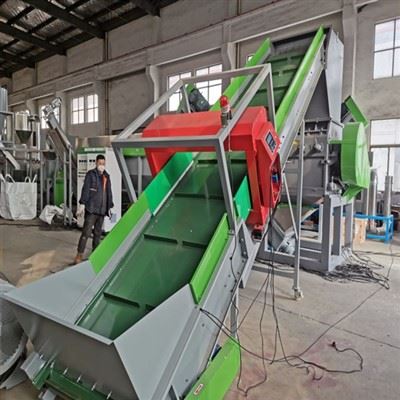
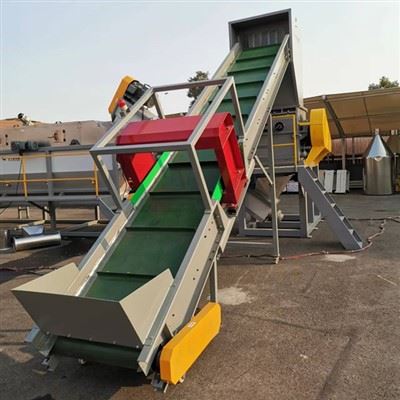
·Equipment: unpacking machine, conveyor belt, manual sorting platform (or automated sorting robot).
·Process: The packaged waste bottle bags are opened and transported by a conveyor belt, and obvious non PET impurities (such as large pieces of metal, glass, PVC bottles, other plastic containers, paper, etc.) are removed manually or by a machine vision system.
2. Crushing - Size reduction
·Purpose: To break the entire bottle into small pieces for subsequent deep cleaning and separation.
·Equipment: shredder or crusher (usually designed with blade shearing).
·Process: The bottle enters the enclosed crusher chamber through a conveyor belt and is cut into evenly sized fragments (usually 12-20mm) by high-speed rotating blades. During the crushing process, a small amount of water will be sprayed to prevent the plastic from melting and bonding due to friction overheating (known as "hot melt"), and to preliminarily wash away some of the sediment.
3. Cleaning - Removing pollutants is the key to the entire production line, usually divided into multiple processes that progress layer by layer.
·Pre cleaning/Friction cleaning:
·Purpose: To forcefully remove stubborn labels, glue, mud, and grease adhered to bottle tablets.
·Equipment: Friction cleaning machine.
·Process: The bottle, water, and cleaning agent are vigorously scrubbed in a tilted tank through the propulsion of spiral blades and the friction between materials. The dirty water is discharged through the bottom sieve.
·Flotation separation/hydraulic separation:
·Purpose: To separate PET and impurities using density differences.
·Equipment: flotation cleaning tank or hydraulic cyclone.
·Process:
·PET bottle slices: with a density greater than water ( about 1.38 g/cm ³), they will sink to the bottom of the pool and be pushed out by the screw conveyor.
·Bottle cap material (PP/PE): with a density lower than water (about 0.90-0.96 g/cm ³), it will float on the water surface and be separated by scraper or overflow.
·This is a crucial step in separating the bottle cap from the bottle body.
·High temperature alkaline washing:
·Purpose: To thoroughly remove organic pollutants such as oil, residual sugar, and glue, and to disinfect and kill bacteria.
·Equipment: Hot wash tank or hot wash tank.
·Process: The bottle slices are soaked in heated alkaline cleaning solution (usually NaOH solution, temperature above 80 ℃) and slowly stirred to emulsify and decompose pollutants.
·Rinse:
·Purpose: Thoroughly rinse off the residual cleaning agent and stripped dirt on the bottle slices that have been washed with alkali.
·Equipment: Multi stage rinsing tank or drum rinsing machine.
·Process: Adopting the principle of reverse flow rinsing, that is, the cleanest bottle slices enter the cleanest water, and the direction of water flow is opposite to the direction of material advancement, in order to achieve water conservation and optimal cleaning effect.
4. Dehydration - mechanical dehydration
·Objective: To remove as much free water as possible from the surface of the bottle slices before entering the drying system, in order to significantly reduce drying energy consumption.
·Equipment: Centrifugal dewatering machine.
·Process: After cleaning, the wet bottle pieces enter the high-speed rotating centrifuge basket. Under the huge centrifugal force, the moisture is thrown out and discharged through the sieve holes on the basket wall, and the moisture content of the material can be reduced to below 10%.
5. Drying - Thermal Dehumidification
·Purpose: To completely evaporate the residual moisture inside and on the surface of the dehydrated bottle, so that it meets the requirements for subsequent processing or storage (the moisture content is usually required to be less than 1%).
·Equipment: Airflow drying system (most common), friction dryer, etc.
·Process: High temperature and high-speed hot air come into full contact with the bottle slices, taking away moisture and forming humid and hot exhaust gas. The dried bottle slices are cooled by the cooling system and then discharged.
6. Packaging and Storage
·Purpose: Properly package the finished product to prevent moisture and contamination.
·Equipment: silo, automatic packaging machine, ton bag packaging machine.
·Process: After drying, the clean PET bottle pieces are sieved out of small particles by a vibrating screen machine and stored in a material bin. Finally, they are automatically weighed and packed into large bags or ton bags.
Production line flowchart (simplified material flow)
Waste bottle feeding → unpacking machine → conveyor belt (manual/mechanical sorting) → crusher (with water spray) → friction cleaning machine → flotation separation tank (separating PP/PE bottle caps) → high-temperature alkali washing tank → multi-stage rinsing tank → centrifugal dewatering machine → airflow drying system → vibrating screen → finished product bin → packaging machine → clean PET bottle final product and
application
·Product: Clean PET Flakes
·Features: White and pure appearance, low impurity content, and low moisture content.
·Main purpose:
1. Spinning: Manufacturing polyester short fibers for filling materials (such as toy filling cotton), non-woven fabrics, and textile fabrics.
2. Sheet: Production of APET sheets for food vacuum packaging, blister packs, etc.
3. Granulation: PET recycled pellets (RPET pellets) are melted and granulated by a screw extruder, which can be used for injection molding or blow molding into non food contact containers.
4. Bottle to bottle: After undergoing advanced deep cleaning and solid-phase thickening (SSP) processes, it can be used to produce new beverage bottles.
Key technologies and considerations
1. Separation technology: Efficient separation of PET bottle body (transparent, blue, green) from HDPE bottle cap, PP label paper, aluminum ring, glue, and other plastics is the core to ensure the purity of the finished product. Advanced factories will use near-infrared sorting machines (NIR) for precise color and material sorting before and after crushing.
2. Sewage treatment: The cleaning process generates a large amount of wastewater, and it is necessary to build a sewage treatment system (such as sedimentation, air flotation, biochemical treatment, etc.) to achieve wastewater recycling or standard discharge, otherwise it will cause secondary pollution.
3. Energy consumption control: Drying is the main energy consuming link, so efficient dehydration equipment is crucial.
4. Automation level: The higher the automation level, the lower the labor cost, the more stable the product purity, but the initial investment is also greater.
I hope this detailed explanation can help you fully understand the PET bottle crushing washing recycling machine. If you have any specific details that you would like to learn more about, please feel free to contact us for consultation.
Advantages
1. Final products has good quality. When process PET bottles, final products humidity below 1%.
2. The machine with high efficiency, working stable, large capacity etc.
3. Parts which contact material use SUS304, thickness more than 3mm, ensure long service life time.
4. World famous brand components applied on the production line- SKF bearing, Siemens contactor, Japan Omron temperature controller, ABB invertor, Siemens PLC control.
|
Model |
CAPACITY (kg/h) |
POWER CONSUMPTION (kw) |
WATER CONSUMPTION (ton/h) |
Manpower |
HUMIDITY CONTENT |
|
PET-300 |
300kg/hour |
150kw |
3ton/h |
4 |
<1% |
|
PET-500 |
500kg/hour |
230kw |
4-5ton/h |
4 |
<1% |
|
PET-1000 |
1000kg/hour |
270kw |
6-7ton/h |
5-6 |
<1% |
|
PET-2000 |
2000kg/hour |
370kw |
8ton/h |
5-6 |
<1% |
|
PET-3000 |
3000kg/hour |
420kw |
10ton/h |
7 |
<1% |
Hot Tags: pet bottle crushing washing recycling machine, China pet bottle crushing washing recycling machine manufacturers, suppliers, factory, polystyrene recycling equipment, shredding plastic machine, household plastic shredder, pp granulator machine, pet flakes to fiber machine, pet bottle recycling machine price
You Might Also Like


Send Inquiry