


PP PE Bottle Crushing Washing Recycling Machine

PP PE Bottle Crushing Washing Recycling Machine suppliers

PP PE Bottle Crushing Washing Recycling Machine factory

PP PE Bottle Crushing Washing Recycling Machine best

PP PE Bottle Crushing Washing Recycling Machine high quality

PP PE Bottle Crushing Washing Recycling Machine price

PP PE Bottle Crushing Washing Recycling Machine high quality

PP PE Bottle Crushing Washing Recycling Machine high quality
PP PE Bottle Crushing Washing Recycling Machine
The PP PE bottle crushing washing recycling machine is a set of equipment specifically designed to process waste PP (polypropylene) and PE (polyethylene) bottle materials (such as yogurt cups, shampoo bottles, medicine bottles, milk bottles, daily chemical bottles, etc.) and convert them into high-purity recycled plastic sheets (Flakes) or pellets (Pellets).
PP and PE are two different plastics, but their densities are lower than water and their recycling processes are similar. Therefore, they are often processed in the same production line and ultimately separated or mixed into granules according to customer needs.


Core process flow
Similar to film lines, but optimized for bottle characteristics such as bottle caps, labels, and residual contents.
1. Preprocessing - unpacking and sorting
·Purpose: To remove large impurities and prepare for subsequent processing.
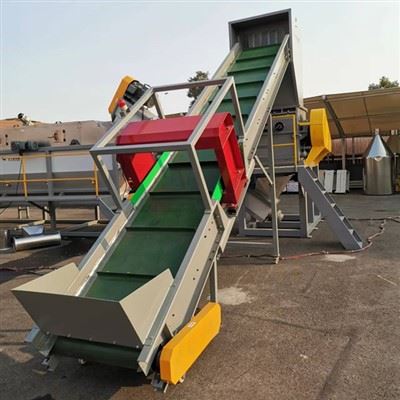
·Equipment: unpacking machine, conveyor belt, manual sorting platform.
·Process: The packaged waste bottle bags are opened and transported by conveyor belt, and obvious non PP/PE impurities (such as PET bottles, metals, glass, other plastics, etc.) are manually removed.
2. Crushing - Size reduction
·Purpose: To break the entire bottle into small pieces, separating the bottle body, cap, and label for easy cleaning.
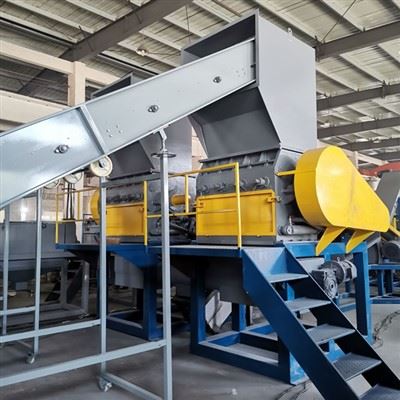
·Equipment: Crusher (usually designed with blade cutting, requiring anti entanglement).
·Process: The bottle enters the enclosed crusher chamber through a conveyor belt and is cut into evenly sized fragments (usually 10-15mm) by high-speed rotating blades. During the process, a small amount of water can be sprayed to cool down and prevent dust.
3. Hot washing - removing pollutants
·Purpose: This is the most essential cleaning step, which uses heating and cleaning agents to forcefully remove the grease, residual liquid, label paper, and glue adhered to the bottle slices.
·Equipment: Hot washing tank or friction cleaning machine.
·Process: The crushed sheet, hot water, and specialized cleaning agent are mixed together into a container and continuously cleaned at a temperature above 80 ℃ through spiral stirring or friction. The high temperature causes the glue to fail, the label paper to become fibrous, and the grease to emulsify and decompose.
4. Flotation separation - sorting bottle body and bottle cap
·Purpose: To use density difference to automatically separate PP bottle slices, PE bottle slices, and bottle cap materials.
·Equipment: flotation cleaning tank or hydraulic cyclone.
·Process:
·PET bottle flakes (if residual): with the highest density (~1.38g/cm ³), they will sink to the bottom first and be separated separately (usually PET should not be mixed in PP/PE bottles, but it can be used as a safety link).
·PP bottle slices: with a density of about 0.90-0.91g/cm ³, they will suspend in water or slowly sink.
·HDPE bottle flakes (such as baby bottles): with a density of about 0.94-0.96g/cm ³, they will be suspended in the middle layer.
·Bottle cap (PP/PE): with the lowest density (~0.90-0.92g/cm ³), it will float on the water surface and be separated by scraper or overflow.
·By adjusting the density of water (such as adding CaCl ₂, etc.), PP and HDPE can be separated more accurately.
5. Friction cleaning - deep scrubbing
·Purpose: To perform final fine washing on the separated bottle slices to thoroughly remove any residual trace pollutants.
·Equipment: High speed friction cleaning machine.
·Process: The material is driven by high-speed rotating blades inside the cleaning machine, which generate intense friction with each other and water, further peeling and cleaning stubborn stains on the surface.
6. Rinse - Final Purification
·Purpose: Thoroughly rinse off the residual cleaning agent and stripped dirt on the bottle slices that have undergone hot washing and friction washing.
·Equipment: Rinse tank or drum rinse machine.
·Process: Reverse flow rinsing with clean water is used to achieve the best cleaning effect in the most water-saving way.
7. Dehydration - mechanical dehydration
·Purpose: To remove moisture to the maximum extent possible and save energy for drying.
·Equipment: Centrifugal dewatering machine.
·Process: The wet sheet rotates in a high-speed centrifuge, and the surface moisture is completely shaken out, reducing the moisture content to below 10%.
8. Drying - Thermal Dehumidification
·Purpose: To achieve the extremely low moisture content (<1%) required for subsequent processing of materials.
·Equipment: Airflow drying system (most commonly used).
·Process: High temperature hot air comes into full contact with the material, instantly evaporates water, and produces dry, loose clean bottle slices.
9. Wind selection and packaging
·Purpose: To remove possible residual light impurities (such as label paper fragments) and package them properly.
·Equipment: air separator, vibrating screen, silo, packaging machine.
·Process: After drying, the material is passed through a wind separator to separate light impurities using wind power; Vibrating screen to remove fine particles; Finally, high-purity PP/PE bottle slices are obtained and packaged for storage.
10. Extrusion granulation (optional)
·The dried clean sheet can be melted, filtered (screen changer), and pelletized using a single screw extruder to produce higher value recycled plastic pellets.
Production line flowchart (simplified material flow)
Waste bottle feeding → unpacking → conveyor belt (manual sorting) → crusher → conveying → hot washing tank (heating+cleaning agent) → spiral lifting → flotation separation tank (separating bottle caps from different density materials) → friction cleaning machine → clear water rinsing tank → centrifugal dewatering machine → airflow drying system → air separator → vibrating screen → finished product bin → (optional) extrusion granulator → packaging
(Discharge dirty water) (Scrape off bottle caps) (Discharge wastewater)
Final product and application
·Product: Clean PP/PE recycled bottle flakes or PP/PE recycled particles.
·Application:
·Automotive accessories: bumpers, interior panels, battery casings, etc.
·Appliance shell: washing machine inner bucket, air conditioning shell, small appliance shell, etc.
·Daily necessities: trash cans, flower pots, turnover boxes, tables and chairs, pallets.
·Pipe materials: municipal drainage pipes, wire and cable sheaths.
·Injection molded products: various industrial parts and civilian products.
Key technologies and considerations
1. Separation technology is the core: the key to success lies in efficiently separating the bottle body, bottle cap, and label. Although the material of the bottle cap (PP/PE) may be the same as the bottle body, the color and melt index are different, and mixing will affect the quality, so flotation separation is crucial.
2. Removing labels and adhesives is a difficult task: the labels and adhesives of daily chemical bottles are very stubborn and must rely on high temperature, strong cleaning agents, and sufficient friction cleaning time to effectively remove them. The residual glue will carbonize during melting and granulation, forming black spots and affecting product quality.
3. Density regulation: To produce recycled PP or PE materials of a single material, it may be necessary to use density regulators (such as saltwater) for more precise separation in the flotation cell.
4. Sewage treatment: The cleaning process generates a large amount of wastewater containing chemical cleaning agents and oils, which must be accompanied by a complete sewage treatment system (sedimentation, air flotation, biochemical treatment, etc.).
5. Differentiated processing: The process parameters (such as temperature and cleaning agent formula) for processing HDPE milk bottles and PP daily chemical bottles may need to be adjusted and optimized.
I hope this detailed process description can help you fully understand the process and equipment of PP/PE bottle recycling line. If you have specific materials (such as mainly HDPE milk bottles or PP daily chemical bottles) that need to be processed, the process will be slightly more focused.
|
Type |
PE500 |
PE1000 |
PE2000 |
PE3000 |
|
|
Capacity(kg/h) |
500 |
1000 |
2000 |
3000 |
|
|
Energy consumption(KWH) |
119 |
165 |
209 |
294 |
|
|
Installation power(KWH) |
183 |
254 |
322 |
452 |
|
|
Chain conveyor |
chain plate width(MM) |
800 |
1000 |
1400 |
1600 |
|
Drive motor (KW) |
2.2 |
3 |
4 |
5.5 |
|
|
Shredder |
Grind chamber(mm) |
840*1570 |
1120*1570 |
1400*1570 |
1960*1570 |
|
Motor power(KW) |
37 |
55 |
75 |
55*2 |
|
|
Crusher |
Grind chamber(mm) |
500*700 |
700*1000 |
700*1200 |
800*1200 |
|
Motor power(KW) |
55 |
75 |
90 |
132 |
|
|
Belt conveyor |
Belt width(mm) |
600 |
800 |
800 |
1000 |
|
Motor power(KW) |
2.2 |
3 |
3 |
3 |
|
|
Washing tank |
Dimension of tank(mm) |
5000mm×1200mm |
6000mm×1600mm |
8000mm×1800mm |
10000mm×1800mm |
|
No. of thumb-wheel(pcs) |
5 |
6 |
8 |
5 |
|
|
Screw conveyor |
Screw diameter(mm) |
250 |
300 |
400 |
500 |
|
Motor power(KW) |
2.2 |
3 |
4 |
5.5 |
|
|
Friction washer |
Screw diameter(mm) |
300 |
400 |
450 |
560 |
|
Motor power(KW) |
11 |
15 |
22 |
30 |
|
|
Centrifugal dryer |
Rotor diameter(mm) |
460 |
500 |
550 |
650 |
|
Motor power(KW) |
15 |
22 |
30 |
45 |
|
|
Hot air pipe dryer |
Pipe diameter(mm) |
133 |
159 |
169 |
219 |
|
Heating power(KW) |
36 |
36 |
48 |
55 |
|
Hot Tags: pp pe bottle crushing washing recycling machine, China pp pe bottle crushing washing recycling machine manufacturers, suppliers, factory, polystyrene recycling equipment, shredding plastic machine, household plastic shredder, pp granulator machine, pet flakes to fiber machine, pet bottle recycling machine price
Previous
No InformationYou Might Also Like


Send Inquiry